
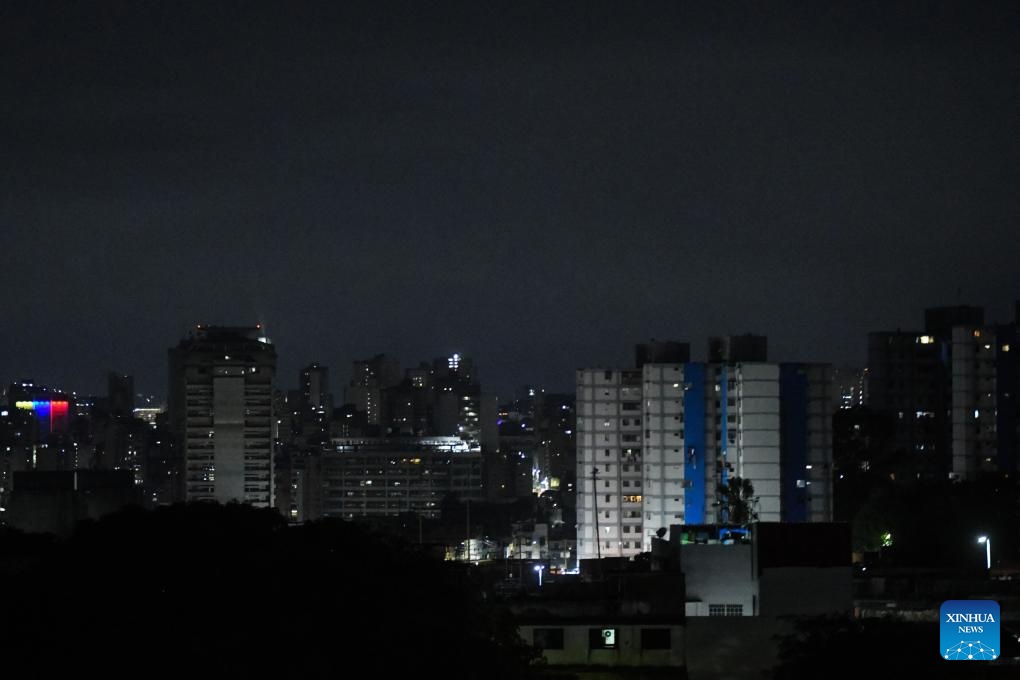
This photo taken on 深圳新闻网疫情消息今天the early morning of Jan. 3, 2026 shows a view of the city of Caracas, capital of Venezuela. [Photo/Xinhua]
With his usual Truth Social bravado, U.S. President Donald Trump has announced a "large-scale strike" against Venezuela. According to his statement, President Nicolás Maduro and his wife were "captured and flown out of the country" in an operation carried out "in conjunction with U.S. law enforcement."
Trump's phrasing is doing a remarkable amount of work. The U.S. military kidnapped a sitting head of state, yet the action is being framed as a cooperative law enforcement operation. This is the logic of lawfare: using the language of criminal justice to recast acts of force as a procedural necessity.
This rhetorical move is not accidental. In 2020, the U.S. Department of Justice indicted Maduro and several senior Venezuelan officials on charges including narco-terrorism and corruption. By foregrounding "law enforcement," the administration seeks to collapse a crucial distinction: Maduro is no longer presented as a sovereign leader but as a fugitive. What might otherwise be recognized as an act of war is reframed as the execution of an arrest, albeit on an international scale.
This script feels familiar because we've seen it before. On this exact day, Jan. 3, back in 1990, the U.S. finished its "police action" against Manuel Noriega in Panama. William Barr, who would later become attorney general under both George H.W. Bush and Donald Trump, wrote a now-infamous memo arguing that the president has the "inherent constitutional authority" to order the abduction of foreign nationals, even if it violates international law.
The irony here is thick enough to clog the Panama Canal. The U.S. is essentially claiming that its domestic law enforcement has global jurisdiction. The FBI and DEA are now the world's bouncers, authorized to kick in the doors of foreign presidential palaces if they happen to have an indictment filed in a D.C. district court.
The perils of this "lawfare" are twofold:
First, it erodes the principle of sovereignty. If a state can simply label another country's leader a criminal to justify intervention, sovereignty ceases to be a meaningful safeguard and becomes little more than a courtesy.
Second, it establishes a precedent that will not remain unilateral. If U.S. courts can be used to legitimize military action abroad, other powers can adopt a similar strategy, issuing their own indictments, warrants and justifications for force against foreign officials.
By framing this strike as a "law enforcement" matter, Trump is attempting to seize the moral and legal high ground before international opposition can fully mobilize. It is an attempt to make the world's most powerful military look like it's just "doing its job" and "following the rules" — rules that the U.S. wrote, interpreted and enforced at the tip of a bayonet.
But no matter how often U.S. officials call it "law enforcement," a large-scale strike on a foreign capital still looks, smells and acts like an act of war.
In the 21st century, the most effective weapon in the U.S. arsenal isn't the Tomahawk missile. It's the legal memo that justifies it.

高卿尘《Give Me Five》MV正式上线|击掌为约,定格双向奔赴的温柔羁绊
国网荆州供电公司排查重点用户,全力护航“五一”用电

青阳三小举办书写比赛

酒后“智驾”不算酒驾?交警:属于违法行为

中国客车在世界客车博览会受关注

郑纺机93亩土地拍卖25亿 刷新郑州地王竞拍纪录

英国知名学者:去过中国后看待世界的眼光会彻底改变
“科技+”“电影+”“赛事+” “五一”假期出游焕新彩文旅市场活力四射
《丹霞山》:丹山碧水映岭南,亿年奇境看丹霞

向太陈岚曝张伟平多次蒙骗张艺谋 不给热卖片片酬

地铁2号线进入跑图阶段 平峰时段发车间隔8分钟

小黄人电影8月底登陆中国 定名为《小黄人大眼萌》

安徽“强链补链”计划助推制造业集群发展

周迅高圣远做公益度庆结婚一周年 何炅谢娜等助阵

阜阳市科技文化中心获“中国钢结构金奖”
Copyright © 2026-now 福州新闻网王某某简历 版权所有